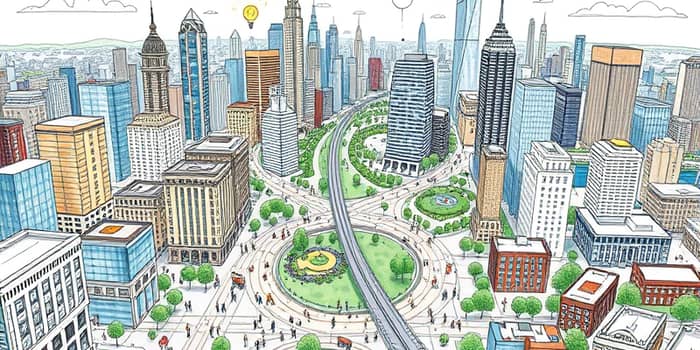
Since the mid-20th century, cities have not merely expanded in size—they have transformed into powerhouse economies driving global prosperity. This article examines the multifaceted ways in which urbanization fuels growth, the regional dynamics at play, and the sustainable strategies needed to balance opportunities with challenges.
Historical Rise of Urban Economies
Between 1950 and 2018, the world’s urban population experienced a six-fold increase from 751 million to 4.2 billion. This dramatic shift was propelled by rising fertility rates in certain regions and massive rural-to-urban migration in others. By 2050, urban dwellers are projected to comprise nearly 70% of humanity, adding 2.5 billion people—equivalent to founding a new Providence, Rhode Island, every day for 41 years.
Mid-sized cities (500,000–5 million inhabitants) are at the forefront of this transition, emerging as dynamic hubs of commerce and culture. As rural populations stabilize or decline, urban centers absorb new residents, reshape labor markets, and redefine national development trajectories.
Cities as Powerhouses: GDP and Employment
Urban areas concentrate capital, talent, and infrastructure, accounting for a staggering share of economic output. In the United States, metropolitan regions generated 94.3% of national real GDP growth in 2024, while comprising 90.8% of total GDP. Similarly, 88.2% of American workers are employed within metro boundaries.
These figures underscore why policymakers regard metropolitan regions as the driving engines of modern economies. Even during periods of national slowdown, urban centers maintain momentum through denser networks of business activity and higher rates of innovation.
How Urbanization Sparks Innovation
The clustering effect in cities fosters collaboration, competition, and knowledge spillovers. High-tech corridors, financial districts, and research campuses exemplify how proximity accelerates new ideas into marketable products. Consider Fayetteville, Arkansas: home to Walmart’s headquarters and a growing tech sector, it has leveraged local talent to boost job growth beyond national averages.
- Population concentration enhances labor market efficiency.
- Dense networks accelerate knowledge sharing and R&D.
- Robust infrastructure attracts domestic and foreign investment.
- Cross-industry collaboration fosters entrepreneurial ecosystems.
Regional examples further illustrate these dynamics. North Carolina’s recent influx of finance and pharmaceutical investments has created thousands of high-wage positions. In Utah’s St. George metro, rapid high-tech expansion has driven one of the strongest job growth rates in the country.
2026 Economic Forecasts Through an Urban Lens
Global GDP growth is projected at 2.7% in 2026, a slight decline from pre-pandemic levels. Despite this global slowdown but cities/regions resilient, metropolitan areas continue to outpace national averages, buoyed by consumer demand, investment, and innovation.
United States growth is forecast at 1.7–2.0%, with 94% of gains concentrated in metros. North Carolina and South Carolina are expected to grow by 2.4% and 2.6%, respectively, driven by population inflows and capital projects. In Europe, a 1.3% expansion is anticipated, tempered by geopolitical tensions and tariff uncertainties.
Asia remains a growth engine: China at 4.6% and India at 6.6%, underpinned by urban development and infrastructure spending. African economies, forecast to grow 4.0%, face climate risks in rapidly expanding cities. Latin America’s moderate 2.3% pace hinges on urban consumer markets and public investment.
Future Hotspots and Regional Examples
By 2050, one-third of global urban population growth will occur in India (416 million), China (255 million), and Nigeria (189 million). These megacities—and the numerous mid-sized urban centers—are poised to reshape economic geography.
Some mature metro areas face demographic headwinds. Greater Tokyo, home to nearly 38 million people, is experiencing gradual population decline due to Japan’s low fertility rates. In contrast, Latin American midsize hubs such as Medellín and Monterrey are leveraging urban renewal and tech corridors to attract foreign capital.
Balancing Growth with Sustainability
Rapid urbanization brings both promise and peril. While cities yield higher living standards and innovation, they also generate overcrowding, pollution, and deepening inequalities. Infrastructure deficits—water, energy, transportation, and waste management—can erode urban quality of life and economic resilience.
- Promote inclusive planning with community participation.
- Invest in green infrastructure and public transit.
- Ensure affordable housing near employment centers.
- Implement policies for equitable access to services.
Municipal leaders worldwide are piloting climate-resilient designs, from green roofs to smart grids, recognizing that sustainable practices safeguard long-term economic vitality. Public-private partnerships and participatory governance models are critical to maintaining the social contract in rapidly evolving urban landscapes.
As cities continue to absorb the majority of global population growth, they stand as both the greatest sources of economic dynamism and the most complex arenas for sustainable development. By understanding historical trends, leveraging innovation networks, and prioritizing inclusive, resilient strategies, urban centers can remain the growth engines of the 21st century, powering prosperity for generations to come.
References
- https://desapublications.un.org/publications/world-economic-situation-and-prospects-2026
- https://economics.td.com/state-economic-forecast
- https://www.weforum.org/stories/2019/09/mapped-the-dramatic-global-rise-of-urbanization-1950-2020/
- https://www.developmentaid.org/news-stream/post/186952/urbanization-and-sustainable-cities-development
- https://www.smartcitiesdive.com/news/archive-acc-cities-drive-most-u-s-economic-activity-report/757145/
- https://www.earthdata.nasa.gov/topics/human-dimensions/urbanization-urban-sprawl
- https://www.worldbank.org/en/topic/urbandevelopment
- https://milkeninstitute.org/content-hub/research-and-reports/research-and-data-tools/best-performing-cities-2026-resilience-cooling-economy
- https://kingcenter.stanford.edu/news/future-urban
- https://comptroller.nyc.gov/newsroom/newsletter/new-york-by-the-numbers-monthly-economic-and-fiscal-outlook-no-109-january-2026/
- https://css.umich.edu/publications/factsheets/built-environment/us-cities-factsheet
- https://www.usmayors.org/2025/06/20/new-report-u-s-conference-of-mayors-releases-data-highlighting-metropolitan-areas-as-americas-economic-engines/