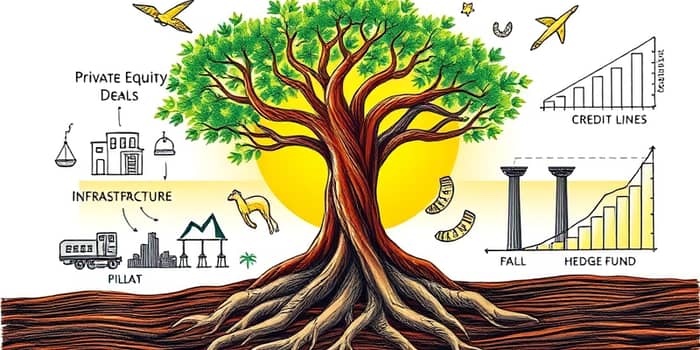
In an era where markets shift with unprecedented speed and concentration, the venerable “60/40” portfolio—the venerable “60/40” mix of bonds and stocks—feels increasingly fragile. Long hailed as the gold standard of balanced investing, it now faces headwinds from soaring technology valuations, rising inflation, and tighter credit spreads.
Today’s investors must ask: can a strategy forged in a different economic age still deliver resilience and growth? This article charts a new path forward, blending inspiring stories with practical guidance, to show how alternatives can reshape your portfolio for enduring success.
The Erosion of Traditional Portfolios
The U.S. equity market has become overwhelmingly dominated by a handful of technology titans. With the "Magnificent 7" accounting for nearly one-third of the S&P 500, equity market concentration at all-time highs threatens broad-based returns and leaves portfolios vulnerable to abrupt sector drawdowns.
Meanwhile, fixed income no longer offers its historical ballast. Credit spreads sit at multi-year tights, and in a regime of inflation and rate volatility, bonds can deliver disappointing real returns. Rising interest rates have fostered a positive stock-bond correlation, eroding the traditional offset between equities and debt.
- Equity dominance: Tech and growth stocks represent nearly half of U.S. market capitalization.
- Tight credit: Corporate bonds trade on minimal yields above Treasuries.
- 60/40 weakness: Rising correlation reduces stability across market cycles.
The Strategic Case for Alternatives
In response to these headwinds, sophisticated investors are turning to alternative asset classes. By seeking exposures outside public equities and core bonds, they aim to capture uncorrelated sources of return and fortify portfolios against market shocks.
Endowments like Yale have demonstrated that non-correlation drives superior returns over the long term. Their success story, once an outlier model, has sparked a surge of institutional adoption, proving that private equity, private credit, hedge funds, and infrastructure can be more than niche allocations—they can be the new cornerstone of resilience.
Emerging and Contrarian Ideas
While alternatives offer a powerful antidote to the limitations of stocks and bonds, innovative investors also embrace contrarian themes. Underexposure to private real-world AI applications and power infrastructure can be a greater risk than overexposure to the next tech bubble.
- Alpha-enhanced equities: blurring passive efficiency with active management.
- Derivative-income ETFs: harnessing options for predictable income streams.
- Reinsurance and catastrophe bonds: truly uncorrelated insurance premiums.
- Offensive risk premia: advanced hedges beyond trend and carry.
- Interval funds: balancing balance liquidity and growth needs within alts.
Implementation Insights for Savvy Investors
Allocating to alternatives is not merely a tactical decision but a strategic imperative. Establishing the right mix requires rigorous due diligence, patient capital, and a willingness to think beyond quarterly reports. The goal is patient capital for long-term success—committing where others hesitate and rebalancing judiciously.
- Define clear objectives: identify risk tolerance, time horizon, and liquidity needs.
- Diversify managers: reduce single-source risk through multiple specialized teams.
- Monitor lock-up periods: align with personal cash flow and obligations.
- Leverage secondaries and continuation funds: improve flexibility as assets mature.
By incorporating a systematic review process, using quantitative benchmarks, and engaging experienced advisors, investors can avoid common pitfalls. Unlocking value beyond traditional benchmarks demands both courage and discipline, but the potential rewards are substantial.
Embracing a New Investment Paradigm
The old diversification playbook isn’t as reliable in a world where the biggest tech names can eclipse entire sectors, and where inflation can erode bond yields overnight. By extending beyond the confines of stocks and bonds, investors access powerful catalysts for growth, income, and stability.
This journey requires a shift in mindset—from viewing alternatives as exotic outliers to recognizing them as essential building blocks of resilient portfolios. With less correlated, enhanced diversification, and by embracing empower your portfolio diversification journey, individuals can forge a path that is both inspiring and practical.
As we step into 2026, the choice is clear: continue relying on a potentially obsolete framework, or adopt unconventional wisdom and build a portfolio that stands the test of time. The future belongs to those who dare to rethink tradition, seize fresh opportunities, and commit to a vision of sustainable wealth.
References
- https://privatebank.jpmorgan.com/nam/en/insights/markets-and-investing/ideas-and-insights/the-new-frontier-3-themes-driving-alternatives-in-2026
- https://www.juliusbaer.com/en/insights/market-insights/market-outlook/market-outlook-2026-alternative-investments/
- https://www.morningstar.com/portfolios/3-contrarian-investment-ideas-2026
- https://am.gs.com/en-us/advisors/insights/article/investment-outlook/portfolio-construction-2026
- https://www.ishares.com/us/insights/inside-the-market/2026-market-outlook-investment-directions
- https://walknercondon.com/blog/rise-of-alternative-investments/
- https://www.youtube.com/watch?v=E7Qy6AJpgg4
- https://www.halberthargrove.com/news-guidance/https-www-halberthargrove-com-news-guidance-alternative-investments-101/
- https://www.blackstone.com/insights/article/office-of-the-cio-2026-investment-perspectives/
- https://www.blackrock.com/us/financial-professionals/insights/investing-in-2026
- https://www.morganstanley.com/im/en-us/individual-investor/insights/series/alternatives-2026-outlooks.html
- https://haloinvesting.com/the-flexibility-advantage-a-smarter-way-to-approach-alternatives-in-2026/