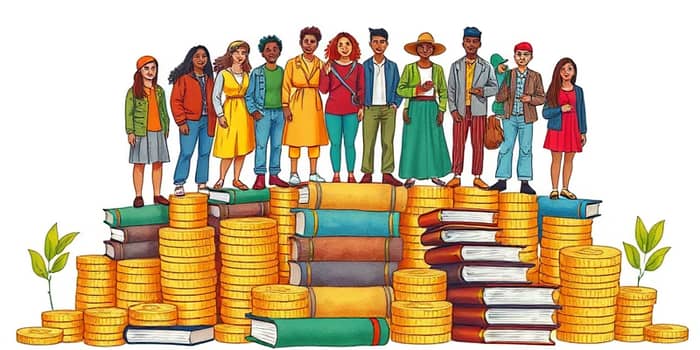
In today's interconnected world, the chasm between the richest and the poorest has never been more pronounced. Millions struggle to make ends meet while a tiny fraction controls vast fortunes. Yet, there is a powerful tool that can help close this divide: financial education.
The Scale of the Problem
We live in an era of extreme wealth concentration. The top 10% of adults globally own roughly 75% of all wealth, while the bottom 50% own only 2%. In many regions, the ratio of wealth between the top tenth and the bottom half exceeds 200 to 1, and in North America and Oceania this gap surpasses 520 to 1.
Income disparities mirror these imbalances. The top 10% of earners receive 53% of global income, more than the combined total of the bottom 90%. Meanwhile, the bottom half of adults capture less than 10% of all income, leaving billions without a fair share of economic growth.
These disparities are not static. In 2025, the richest 1% pocketed over 20% of global income, up nearly 3.5 percentage points since 1980. Billionaire wealth soared by more than 16%, growing to over $18 trillion, while average incomes crept forward at a fraction of that rate.
Evidence for Financial Literacy’s Impact
Amidst this stark backdrop, financial literacy emerges as a beacon of hope. Rigorous studies using instrumental variable approaches confirm that individuals with sound financial knowledge accumulate more wealth, hold diverse assets like pensions and homes, and manage debt more effectively.
- Financial literacy interactions with schooling lead to substantial positive effects on household wealth.
- Higher literacy levels correlate with lower debt-to-assets ratios and more liquid emergency savings.
- Education programs in personal finance yield large payoffs, improving behavior beyond regular curricula.
In the United States, up to half of wealth inequality can be traced to gaps in financial knowledge. Households with higher literacy are more likely to invest in stock markets, own homes, and build retirement savings, creating a virtuous cycle of stability and growth.
How Education Closes the Gap
Financial education equips individuals with the principles and strategies needed for informed decisions. From basic budgeting to advanced investment concepts, these skills empower people to take control of their futures.
- Teaching core concepts like compound interest and diversification fosters long-term wealth accumulation.
- Community workshops and school programs bridge systemic barriers, granting underserved populations access to capital.
- Entrepreneurial training embedded in financial curricula fuels small business growth and local economic development.
By demystifying banking, credit, and investment, financial education becomes a powerful equalizer. It shifts the balance from passive consumers to active wealth builders.
Breaking the Cycle: Wealth, Education, and Mobility
Wealth and education share a cyclical relationship. Families with assets can invest in better schools, tutors, and enrichment programs, boosting academic success from early grades through college. Conversely, children from low-wealth households often miss critical resources during their most formative years.
These disparities compound over generations. Globalization may narrow gaps between nations, but within countries the divide widens. Without intervention, the cycle perpetuates, locking millions into economic stagnation.
These figures tell a story of entrenched advantage and systemic exclusion. But they also highlight where targeted financial education can make the greatest impact.
Policy Recommendations and Practical Steps
Effective change requires collaboration across sectors. Governments, schools, and community organizations each play vital roles in designing and delivering financial education initiatives.
- Integrate personal finance into school curricula from middle grades onward, ensuring early foundational knowledge.
- Offer accessible workshops for adults in underserved areas, leveraging local leaders to foster trust and relevance.
- Partner with financial institutions to provide low- or no-cost advisory services, bridging the knowledge gap without profit motives.
On an individual level, starting with small, consistent habits—such as tracking expenses, setting budgets, and exploring basic investments—can ignite momentum toward greater financial security.
Communities can establish peer-led saving circles or cooperative lending groups, pooling resources while building trust and shared responsibility. Employers can also support by offering lunchtime seminars, matched savings plans, and clear, jargon-free retirement options.
At the national level, policy-makers should recognize financial education as a public good. Investments in teacher training, digital learning platforms, and community outreach yield returns far exceeding their costs, unlocking opportunity for millions.
By weaving financial literacy into the fabric of society, we create a ripple effect: empowered individuals, resilient households, and vibrant economies. In this way, education becomes more than knowledge—it becomes a bridge across the wealth gap.
The challenge is immense, but the solution is within reach. Together, through determination and collaboration, we can ensure that no one is left behind in the march toward prosperity.
References
- https://www.socialjustice.ie/article/world-inequality-report-2026
- https://pmc.ncbi.nlm.nih.gov/articles/PMC3554245/
- https://wir2026.wid.world/insight/global-economic-inequity/
- https://thefare.org/bridging-the-wealth-gap-the-power-of-financial-education/
- https://wid.world/news-article/world-inequality-report-2026-inequality-persist-at-a-very-extreme-level/
- https://www.stlouisfed.org/publications/page-one-economics/2017/01/03/education-income-and-wealth?edu-embed=1
- https://inequality.org/facts/global-inequality/
- https://www.nea.org/resource-library/financial-literacy-economic-inequality
- https://www.oxfam.org.uk/get-involved/campaign-with-oxfam/fight-inequality/oxfams-global-inequality-report/
- https://www.ihep.org/publication/wealth-race-and-higher-education/
- https://worldpopulationreview.com/country-rankings/wealth-inequality-by-country
- https://record.umich.edu/articles/research-shows-how-wealth-begets-educational-disparity/
- https://www.nefe.org/news/2024/08/the-importance-of-equity-in-financial-education.aspx