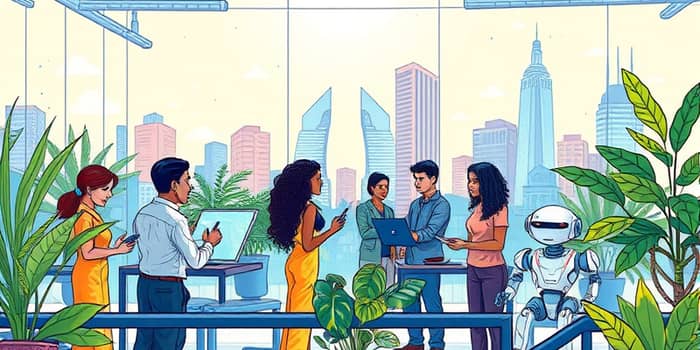
The global labor landscape is undergoing a profound metamorphosis driven by powerful economic tides. This article explores the major forces shaping careers, the challenges of displacement and reskilling, and emerging opportunities in a hybrid, AI-augmented world. By understanding these shifts, readers will be equipped to navigate the new terrain of work with confidence and creativity.
Major Economic Drivers Shaping the Future of Work
At the forefront of this transformation lie five macrotrends that are redefining how, where, and why we work. Leaders and professionals alike must take note of these trends to remain competitive and resilient over the coming years.
- Technological change and digital innovation
- The global green transition and sustainability efforts
- Geoeconomic fragmentation and shifting trade landscapes
- Rising economic uncertainty and cost of living pressures
- Demographic shifts and evolving workforce compositions
In particular, broadening digital access is most transformative, with six in ten employers predicting major upheaval in operations and value chains by 2030. Breakthroughs in artificial intelligence and information processing have already moved from theory into practice, reshaping customer experiences, supply chains, and decision making.
Job Displacement vs. Job Creation: The Net Effect
While automation and robotics will render certain roles obsolete, the overall employment outlook remains hopeful. By 2030, projections suggest a displacement of 92 million positions globally, counterbalanced by the creation of 170 million new roles—a net growth of seventy-eight million jobs.
The sectors leading job creation include:
- Technology and software development
- Renewable energy and green infrastructure
- Healthcare, caregiving, and human-centric services
- Data analytics, cybersecurity, and AI system management
This dynamic underscores the capacity of innovation to generate new pathways even as it transforms existing functions. Professionals must remain agile, anticipating emerging fields and aligning their goals with sectors primed for expansion.
Skills Transformation: The Critical Workforce Challenge
As job requirements evolve, so too must the skills of the workforce. Industry analyses indicate that 44% of workers will need significant reskilling or upskilling within the next five years to remain in demand.
Key competencies for the future economy include:
- AI literacy and machine learning fundamentals
- Advanced data analytics and interpretation
- Cybersecurity and risk management protocols
- Creative problem-solving and complex communication
Employees with proficiency in AI now earn a 56% wage premium on average, highlighting the tangible benefits of investing in human-machine collaboration is becoming standard. Across industries from finance to energy, these skill sets translate into productivity gains and career resilience.
The Green Transition and New Economic Landscapes
The shift toward sustainable business models is not only an environmental imperative but also a source of robust job creation. Growth in energy generation, storage, and distribution is projected to drive new roles in research, installation, maintenance, and policy compliance.
Workers who develop expertise in clean technologies, green finance, and environmental management will find themselves at the nexus of ecological progress and economic opportunity. Companies embracing these priorities are constructing a workforce equipped for the net-zero future.
The Hybrid Work Revolution
The pandemic accelerated a trend that is now firmly embedded in corporate culture: hybrid work. By mid-2025, nearly one-quarter of new job postings offered hybrid arrangements, up from 15% just two years prior.
Current distribution of remote-capable roles demonstrates this shift:
- 52% hybrid positions blending office and home work
- 27% fully remote roles offering geographic flexibility
- 21% on-site jobs retaining traditional office requirements
Despite the prevalence of hybrid models, tension remains between employer mandates and employee desires. While 83% of professionals favor flexible schedules, an increasing number of companies now require regular office presence.
Among younger generations, this is a particularly urgent issue: over 65% of Gen Z and Millennial workers would consider leaving their roles rather than return to full-time on-site schedules, signaling a fundamental generational shift in work preferences.
Strategies for Workers and Organizations
To thrive in this evolving landscape, both individuals and businesses must adopt proactive strategies. For workers, committing to lifelong learning through online courses, certification programs, and peer networks can provide a meaningful edge.
Organizations, meanwhile, should prioritize continuous improvement and adapting to trends by investing in talent development, flexible infrastructures, and inclusive cultures.
Key recommendations include:
- Designing personalized reskilling pathways tied to future growth areas
- Implementing robust mentorship and peer-learning communities
- Leveraging AI-driven tools to match talent with evolving job requirements
- Fostering a hybrid-ready environment that supports wellbeing
Key Statistics Summary
Below is a consolidated view of vital metrics guiding the future of work:
As the world of work continues to morph under the influence of technology, environmental priorities, and human aspirations, staying informed and agile will be paramount. By embracing change, pursuing growth opportunities, and fostering inclusive cultures, we can collectively shape a future of work that is resilient, fulfilling, and rich with possibility.
References
- https://meritamerica.org/blog/2025-future-of-jobs-report-takeaways/
- https://blog.getaura.ai/remote-hybrid-work
- https://www.imd.org/blog/learning-and-development/future-of-work/
- https://www.yomly.com/remote-work-statistics/
- https://www.chanty.com/blog/remote-work-statistics/
- https://www.pwc.com/gx/en/issues/workforce/hopes-and-fears.html
- https://www.roberthalf.com/us/en/insights/research/remote-work-statistics-and-trends
- https://www.weforum.org/publications/the-future-of-jobs-report-2025/
- https://www.gallup.com/401384/indicator-hybrid-work.aspx
- https://www.bls.gov/emp/
- https://www.bls.gov/opub/btn/volume-14/telework-trends.htm
- https://www.brianheger.com/5-reports-on-the-future-of-work-since-the-start-of-2025-curated-by-brian-heger/
- https://www.zoom.com/en/blog/remote-work-statistics/
- https://www.oecd.org/en/topics/policy-issues/future-of-work.html
- https://www.weforum.org/stories/2025/08/return-to-office-flexibility-remote-work/
- https://www.mckinsey.com/capabilities/tech-and-ai/our-insights/superagency-in-the-workplace-empowering-people-to-unlock-ais-full-potential-at-work