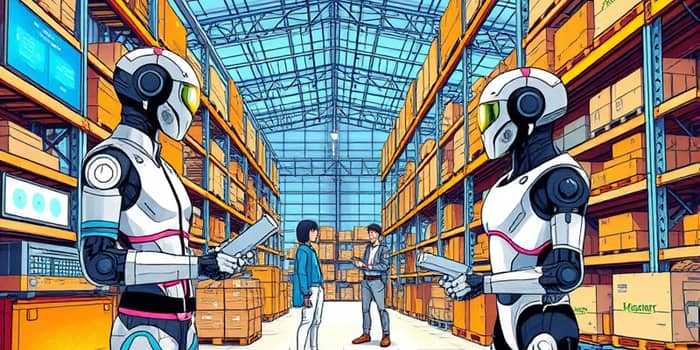
The industrial landscape of 2026 is defined by the interplay between people and machines. Organizations are no longer satisfied with pilot programs or isolated experiments; they are demanding scalable integration of AI-driven processes that deliver measurable impact. As factories, warehouses, and offices transform, the journey from manual routines to intelligent automation shapes not only productivity metrics but the very culture of work.
Automation is no longer about replacing humans but about human-AI collaboration over replacement. By freeing teams from repetitive tasks, companies can unlock creativity and strategic judgment. Yet, this transformation brings challenges in governance, orchestration, and workforce readiness. Success hinges on balancing emerging technologies with responsible implementation and continuous learning.
Evolution of AI in the Workplace
In just a few years, AI has moved from proof-of-concept to core operating models. Legacy ERP systems have evolved into systems of action that guide decision-making, while agentic AI handles execution and coordination of complex workflows. This shift empowers business leaders to focus on strategic objectives rather than monitoring daily exceptions.
Governance frameworks have matured in parallel. Today’s AI deployments prioritize auditability, escalation protocols, and risk management. AI governance as an operating model ensures that large-scale automation remains trustworthy, transparent, and aligned with organizational values. With these foundations in place, companies can harness AI at scale without sacrificing control.
Key Trends Driving 2026
- Agentic AI and orchestration coordinate cross-functional workflows, resolving tool sprawl and ensuring seamless handoffs.
- ERP reimagined as a system of action embeds AI copilots for non-experts and standardizes anomaly detection.
- Resilience prioritizes adaptability over speed, enabling organizations to respond to disruptions with agility.
- Multimodal reasoning AI combines vision and analysis for hands-on tasks like diagnostics and repair planning.
- Hybrid physical-digital work models see AI expanding into roles from plumbing inspections to warehouse quality checks.
- Workforce reskilling amid disruption becomes mission-critical, with half the global workforce needing new skills by 2026.
- Industry-specific automation advances drive cost savings in logistics, manufacturing, finance, and healthcare.
Stats and Projections: The Numbers Behind the Shift
The global AI market is surging, from $515.3 billion in 2023 to $638.2 billion in 2024, and an estimated $757.6 billion in 2025. Projections forecast $1.89 trillion by 2030—nearly a 150% increase in seven years. This growth reflects soaring demand for AI-powered analytics, process automation, and intelligent assistants.
In warehouses, automation adoption is accelerating. Over 4.7 million robots are already operational in 50,000+ facilities. Sales of logistics robots skyrocketed to 450,000 units in 2025—five times the volume of 2019. Companies report 25–30% labor cost reductions, fulfillment speeds 300% faster, and accuracy rates approaching 99%.
Business Process Automation (BPA) follows a similar trajectory. Sixty percent of firms have implemented structured automation, with 84% of large enterprises onboard. By 2026, 30% of enterprises will automate over half of their network operations, and 70% of employees are expected to rely on AI tools by 2028.
Jobs Most and Least Affected
As AI permeates operations, certain roles face high exposure to automation. Tasks that are repetitive, rule-based, or data-intensive are most vulnerable. At the same time, positions that demand empathy, creativity, or complex judgment remain resilient.
- Data entry clerks and administrative assistants
- Manufacturing assembly line workers
- Retail floor staff and checkout operators
- Level 1 customer support agents
- Routine scheduling and coordination tasks in management
- Basic anomaly triage and diagnostics without context
Conversely, roles that involve strategic planning, creative problem-solving, and skilled trades are amplified by AI. Technicians using AI-guided diagnostics, warehouse operatives collaborating with autonomous mobile robots, and managers leveraging intelligent dashboards all experience productivity boosts and deeper job satisfaction.
Industry-Specific Automation Impacts
Every sector is charting its own automation journey. While the core drivers are similar—efficiency, accuracy, resilience—the applications and outcomes vary significantly by industry.
Navigating Challenges and Seizing Opportunities
Automation brings undeniable benefits but also raises legitimate concerns. Nearly 40% of global jobs are exposed to AI-driven change, and industries face skills shortages as they ramp up deployment. Trust gaps persist, with 79% of employees doubting the responsible use of AI in the workplace. Without robust governance and ethical frameworks, inertia could stall progress.
Yet the opportunities are profound. Sixty percent of BPA initiatives deliver positive ROI within a year, and advanced mobile robots achieve over 250% ROI in under 24 months. Eighty-nine percent of employees report higher job satisfaction after automation, thanks to relief from repetitive tasks and focus on high-value work. Organizations that invest in foundations of ethical AI and reskilling are building the resilience needed for tomorrow’s challenges.
Conclusion
The future of work is not a binary choice between humans and machines but a symbiotic ecosystem where each amplifies the other’s strengths. By embracing human-centric AI integration, establishing robust governance, and committing to continuous learning, organizations can transform disruption into a springboard for innovation. The next decade will favor those who view automation not as a threat, but as a catalyst for resilience, creativity, and sustainable growth.
References
- https://www.redwood.com/article/ai-automation-trends/
- https://www.sellerscommerce.com/blog/warehouse-automation-statistics/
- https://www.cognizant.com/us/en/aem-i/ai-and-the-future-of-work-report
- https://www.2am.tech/blog/business-process-automation-statistics-facts-trends
- https://www.weforum.org/stories/2026/01/how-ai-will-affect-work-in-different-industries/
- https://www.crmleaf.app/blog/top-15-workplace-automation-trends-shaping-2026
- https://www.automateshow.com/blog/automation-tips-and-trends-for-2026-how-to-plan-your-next-move
- https://www.companionlink.com/blog/2026/01/ai-in-the-workplace-statistics-2026-adoption-trends-and-future-outlook/
- https://hbr.org/2026/02/9-trends-shaping-work-in-2026-and-beyond
- https://www.deloitte.com/us/en/insights/topics/technology-management/tech-trends.html
- https://www.imf.org/en/blogs/articles/2026/01/14/new-skills-and-ai-are-reshaping-the-future-of-work
- https://www.prsa.org/article/6-workplace-trends-shaping-2026-jan26
- https://charlotteledger.substack.com/p/the-2026-workforce-less-labor-more