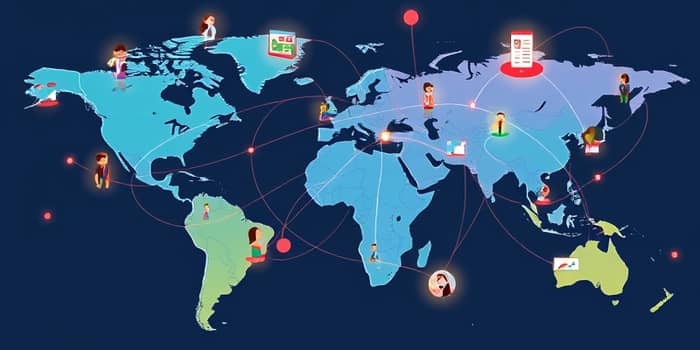
Peer-to-peer lending is revolutionizing the financial world, offering a fresh alternative to traditional banking. This model connects individuals directly through digital platforms, transforming how we access and provide credit.
It empowers borrowers with quick and flexible funding, while giving investors opportunities for higher returns. The rise of fintech has made this possible, creating a more inclusive financial ecosystem.
Globally, the P2P lending market is on a steep upward trajectory. It reached USD 226.34 billion in 2025, with projections indicating explosive growth ahead. This surge reflects a shift towards more efficient and accessible finance.
A Market on the Rise: Global Projections
The global P2P lending market is set for remarkable expansion. By 2035, it is projected to grow to USD 1,837.91 billion, driven by a compound annual growth rate (CAGR) of 23.3% from 2026 to 2035. Alternative estimates suggest even higher figures, highlighting the sector's dynamic nature.
Regional breakdowns show diverse growth patterns. North America dominates with a 34.7% global share, thanks to mature fintech infrastructure. The U.S. market alone was valued at USD 54.47 billion in 2025.
Asia-Pacific is the fastest-growing region, expected to reach USD 470.50 billion by 2035. LAMEA, though emerging, shows significant potential with projections to USD 172.76 billion by 2035.
Key sectors are evolving rapidly. Business loans are the fastest-growing segment, driven by SME demand. In 2025, personal loans accounted for 69.80% of the market, while business loans made up 30.20%.
This growth is fueled by several factors:
- Increasing demand for quick credit solutions.
- Rising adoption of digital finance tools.
- Enhanced financial inclusion in underserved areas.
By 2026, the global market is estimated to hit USD 279.07 billion, underscoring its momentum. Investors and borrowers alike are drawn to its efficiency and accessibility.
What Is Peer-to-Peer Lending and How Does It Work?
Peer-to-peer lending, often called social or crowd lending, originated in 2005. It eliminates intermediaries by connecting borrowers and investors directly via online platforms.
The process is straightforward and digital. Borrowers submit their credit scores, demographics, and financial profiles online. Algorithms then match them with lenders who fund the loans for interest.
Platforms handle all aspects, from automated matching to risk distribution. Lenders can spread their investments across multiple loans, reducing exposure. Transparency is key, with borrower histories often visible to investors.
For example, platforms like Solo Funds allow small emergency loans with personal details shared. This direct approach reduces fees and speeds up approvals significantly.
To participate, borrowers typically need a bank account for transactions. This ensures seamless fund transfers, making the process efficient for all parties involved.
The Engines of Growth: Key Drivers Fueling P2P Expansion
Several factors are propelling the P2P lending market forward. Convenience and speed are primary drivers, offering faster approvals than traditional banks.
This is especially beneficial for SMEs and individuals denied credit elsewhere. The reduced paperwork and online processes make it highly attractive.
Fintech and digitalization play a crucial role. Mobile apps and data analytics enhance credit assessment, building trust in online finance. This technological edge supports higher yields for investors.
Accessibility is another major factor. P2P platforms have lenient criteria, catering to varied credit profiles. This promotes financial inclusion, particularly in emerging markets.
Investors are drawn to the potential for better returns compared to savings accounts. Borrowers benefit from lower rates and flexible terms, creating a win-win scenario.
SME demand is rising, with quick funding needed for growth and e-commerce. Regulatory support from governments and agencies like the SEC also encourages alternative finance.
- Convenience: Faster approvals and minimal paperwork.
- Technology: Use of apps and analytics for efficiency.
- Inclusivity: Lenient credit criteria for broader access.
- Returns: Attractive yields for lenders.
- SME focus: Quick capital for business expansion.
- Regulation: Supportive policies fostering growth.
These drivers ensure that P2P lending remains a vibrant part of the financial landscape. They address gaps left by traditional systems, offering tailored solutions.
P2P vs. Traditional Lending: A Comparative Look
P2P lending complements rather than replaces traditional banks. It thrives in similar areas but offers distinct advantages and challenges. A comparison highlights these differences clearly.
Benefits of P2P lending include accessibility, direct connections, online speed, risk spread, and transparency. These factors make it appealing for middle-class borrowers seeking alternatives.
Drawbacks involve higher risk for lenders due to less regulation. Traditional lending offers stability and variety, with heavy regulation providing protection. However, P2P's agility addresses specific needs efficiently.
P2P lending focuses on small loans and quick approvals. It serves as a substitute for some bank customers but complements the overall system. This synergy enhances financial options for consumers.
Complementing the Giants: P2P and Banks in Harmony
P2P lending coexists with traditional banks, filling gaps in the market. It supports bank borrowers by offering additional options for credit access. This complementary relationship benefits the entire financial ecosystem.
Banks retain an edge in stability and comprehensive services. P2P platforms excel in areas like small, quick loans, which banks may overlook. This dynamic allows both to thrive without direct competition.
Academic studies confirm that P2P lending acts as a substitute for some but complements overall. It aids those with bank access rather than targeting the unbanked. This focus ensures it serves a niche effectively.
- Coexistence: P2P and banks support each other.
- Gap-filling: P2P addresses small loan needs.
- Stability: Banks provide regulated security.
- Innovation: P2P introduces digital efficiencies.
This harmony promotes a more resilient financial system. It encourages innovation while maintaining the trust associated with traditional institutions.
Navigating the Risks: Challenges in the P2P Landscape
Despite its growth, P2P lending faces several risks and challenges. Default potential is a key concern for lenders, as platforms have less regulation than banks. This requires careful risk management from investors.
Platform failures can occur, especially in markets where they play a minor role compared to banks. Direct models eliminate intermediaries but may struggle in certain regions, as seen in Israel-like markets.
General risks include:
- Credit risk from borrower defaults.
- Regulatory uncertainty in some areas.
- Market volatility affecting returns.
- Technological issues on platforms.
- Liquidity challenges for investors.
To mitigate these, platforms use algorithms for risk distribution and transparency. Investors are advised to diversify their portfolios across multiple loans. This approach helps balance potential losses with gains.
Understanding these risks is crucial for anyone involved in P2P lending. It ensures informed decisions and sustainable participation in this evolving market.
Regional Spotlight: Where P2P Is Thriving
Different regions show varied adoption rates and growth potentials for P2P lending. North America leads with mature fintech and regulatory clarity, driving consumer credit growth.
Asia-Pacific is experiencing a digital surge, with countries like India implementing RBI regulations to foster P2P lending. This region's focus on financial inclusion boosts its rapid expansion.
LAMEA is an emerging market, with SMEs adopting P2P solutions for growth. Although smaller in scale, it represents significant opportunities for future development.
Sector insights reveal that consumer lending dominates, but business loans are growing fastest. E-commerce and startups are key drivers, requiring flexible funding options.
- North America: High adoption due to tech infrastructure.
- Asia-Pacific: Fast growth from digitalization efforts.
- LAMEA: Emerging potential in SME sectors.
- Sectors: Consumer loans lead, business loans surge.
These regional trends highlight the global nature of P2P lending. They show how local factors influence its adoption and success.
The Future Is Now: Trends Shaping Tomorrow's Lending
Recent developments point to exciting trends in P2P lending. SMEs are increasingly shifting from banks to P2P platforms for quicker funding. This trend supports business expansion and innovation.
Technological advancements like AI and Web3 are transforming risk assessment and platform operations. These tools enhance efficiency and security, making P2P lending more robust.
Platform innovations are rising, with improved user interfaces and investor participation. Studies, such as those in Managerial Finance, continue to explore P2P's role in finance.
Key trends include:
- Increased use of AI for credit scoring.
- Integration of blockchain for transparency.
- Growth in cross-border P2P lending.
- Enhanced regulatory frameworks globally.
- Rising investor education and engagement.
These trends ensure that P2P lending remains at the forefront of financial innovation. They promise a future where borrowing and investing are more connected and accessible than ever.
As the market evolves, it will continue to inspire new ways of thinking about finance. Embracing these changes can lead to greater financial empowerment for all.
References
- https://www.cervicornconsulting.com/peer-to-peer-lending-market
- https://www.lakeforest.edu/news-and-events/study-uncovers-unexpected-relationship-between-banks-and-peer-to-peer-lending
- https://market.us/report/peer-to-peer-lending-market/
- https://blog.credgenics.com/p2p-lending-vs-traditional-lending/
- https://www.skyquestt.com/report/peer-to-peer-lending-market
- https://www.experian.com/blogs/ask-experian/p2p-vs-traditional-lending/
- https://www.cognitivemarketresearch.com/regional-analysis/north-america-peer-to-peer-lending-market-report
- https://academic.oup.com/rfs/article/32/5/1900/5427773
- https://absrbd.com/post/peer-peer-p2p-lending-statistics
- https://pmc.ncbi.nlm.nih.gov/articles/PMC8210520/
- https://www.kemba.org/resources/education/traditional-banks-vs-p2p-networks
- https://www.maclear.ch/blog/is-p2p-lending-a-threat-or-complement-to-traditional-banking