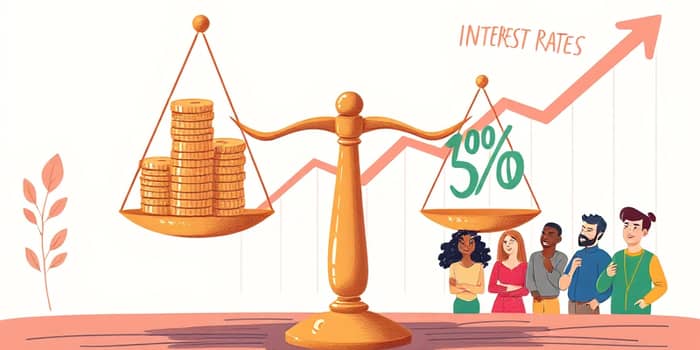
Interest rates might seem like an abstract concept, but they touch every aspect of your financial life. Understanding how they work and change can help you make smarter decisions, protect your budget, and seize new opportunities.
Understanding the Basics of Interest Rates
At its core, an interest rate is the cost of borrowing money expressed as a percentage of the principal. If you borrow funds, you pay interest; if you lend or save, you earn interest. Two key terms form the foundation of this concept:
- Principal: the original amount borrowed or invested.
- Interest: the fee paid for using that money over time.
Simple interest is calculated solely on the principal amount. For example, borrowing $1,000 at an annual rate of 5% for two years costs $100 in interest ($1,000 × 5% × 2). Compound interest, by contrast, reinvests accrued interest, accelerating growth or debt depending on whether you’re saving or borrowing.
The Federal Reserve’s Role in Rate Decisions
The U.S. central bank, the Federal Reserve, wields enormous influence through its federal funds rate targeting. By raising or lowering this rate, the Fed encourages banks to adjust their lending and saving rates accordingly.
When the Fed raises the federal funds rate, borrowing costs climb, which can slow inflation but also dampen economic growth. Conversely, when the Fed lowers rates, loans become cheaper, helping to stimulate spending and investment.
Projections for 2025: What to Expect
Economists and central bankers anticipate several rate cuts in 2025, aiming to bring the federal funds rate down to around 3.5–3.75%. Yet these levels will still represent one of the highest rate environments since the 2008 financial crisis. Mortgage rates are expected to hover in the 6% range, creating a potential “new normal” for homebuyers.
Credit card rates are forecast to ease slightly but remain near 20%. That minor drop will have negligible impact on those carrying significant balances; for instance, a 0.5% reduction on a $5,000 balance saves only about $2 in the first month. Certificate of deposit (CD) yields and high-yield savings rates, however, will continue to attract savers with more attractive fixed-income returns.
Impact on Borrowers and Consumers
When interest rates rise, monthly payments on new loans increase, stretching household budgets. Variable-rate loans, such as adjustable-rate mortgages and credit cards, adjust with market rates, meaning your payment could spike unexpectedly.
Carrying high-interest debt becomes costlier, fueling faster growth of outstanding balances. Homeowners may find refinancing existing loans may become unattractive, as the savings from a lower rate might not outweigh closing costs.
- Mortgage Payments: Higher rates raise monthly costs, slowing homebuying.
- Auto Loans: New car financing becomes less affordable.
- Credit Card Debt: Elevated APRs amplify interest charges.
- Business Loans: Entrepreneurs face increased capital costs.
Opportunities for Savers and Investors
While borrowers feel the squeeze, savers benefit from higher interest rates benefit savers. Banks compete to attract deposits by raising APYs on savings accounts, money market funds, and CDs. Long-term investors can find newly issued bonds offer higher yields, locking in more income from fixed-income portfolios.
Stock markets may experience volatility as higher corporate borrowing costs pressure earnings and valuations. Yet this environment can also create attractive entry points for long-term equity investors, especially in sectors that perform well during tightening cycles, such as financial services.
Shifting Consumer Behavior and the Economy
As credit becomes more expensive, discretionary spending often contracts. Major purchases—home renovations, vacations, and big-ticket appliances—frequently get postponed when affordability dips. This spending slowdown can ripple through sectors, from local retailers to global manufacturers, ultimately moderating economic growth.
Consumer spending represents roughly 70% of U.S. economic activity. When households tighten their belts, the impact is felt across industries, underscoring how powerful interest rates can be as a macroeconomic lever.
Strategies to Navigate Changing Rates
Proactive planning is key to weathering interest rate fluctuations. Consider these practical steps:
- Lock in fixed rates where possible to avoid sudden payment hikes.
- Accelerate debt repayment on high-interest balances to reduce total cost.
- Shop savings products regularly to capture the best yields.
- Build an emergency fund to cushion against unexpected rate-driven expenses.
Refinancing may still make sense if you can secure a rate significantly below your existing loan. Keep an eye on closing costs to ensure net savings.
How Fed Actions Ripple Into Personal Finances
Every Fed rate change travels through the economy via banks, lenders, and financial markets. A quarter-point increase in the federal funds rate can raise mortgage and auto loan rates by similar amounts within weeks. Conversely, rate cuts eventually translate into lower borrowing costs, though the lag can be several months.
Understanding this transmission process empowers you to time major financial decisions—such as locking in a mortgage, refinancing debt, or rebalancing your investment portfolio—more effectively.
Preparing for the Future
Interest rates will continue to ebb and flow with economic conditions. Staying informed about Fed announcements, inflation trends, and market forecasts will help you adapt your strategies. By balancing prudent debt management with opportunistic saving and investing, you can harness changing rates to your advantage.
Remember that even in a high-rate environment, disciplined financial habits—consistent saving, diversified investing, and measured borrowing—remain the bedrock of long-term prosperity.
References
- https://www.bankrate.com/personal-finance/interest-rates-forecast/
- https://elevate-wealth.com/higher-interest-rates-affect-personal-finances/
- https://www.cambridgeassociates.com/insight/2025-outlook-interest-rates/
- https://bna.bank/understanding-interest-rates-and-their-impact-on-consumers/
- https://www.guidestone.org/Resources/Education/Articles/Investments/Understanding-Interest-Rates
- https://www.fultonbank.com/Education-Center/Saving-and-Budgeting/4-ways-higher-interest-rates-impact-your-finances
- https://www.invesco.com/us/en/insights/what-is-interest-rate.html
- https://www.bankevanston.com/articles/2022/09/fed-interest-rate-changes-how-does-this-impact-your-personal-finances.html
- https://www.federalreserve.gov/aboutthefed/fedexplained/monetary-policy.htm
- https://www.bankrate.com/banking/federal-reserve/how-federal-reserve-impacts-your-money/
- https://www.usbank.com/financialiq/invest-your-money/investment-strategies/how-do-interest-rates-affect-investments.html
- https://www.vermontfederal.org/blog/how-fed-interest-rate-impacts-you
- https://www.youtube.com/watch?v=P9Hfqo3Vu6c
- https://www.fnbo.com/insights/personal-finance/2025/how-fed-rate-cuts-could-impact-your-personal-finances
- https://www.fdic.gov/national-rates-and-rate-caps
- https://www.discover.com/online-banking/banking-topics/how-does-the-federal-reserve-interest-rate-affect-me/