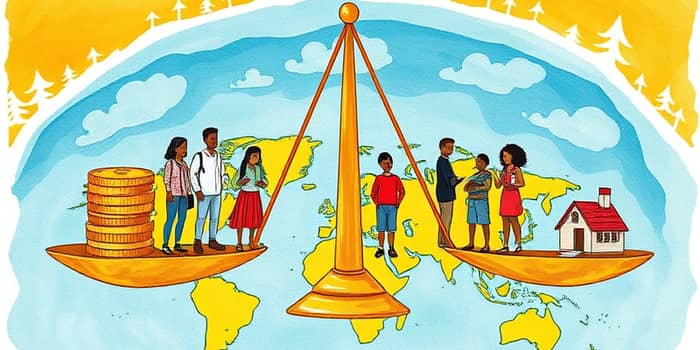
Income distribution and wealth inequality shape the opportunities available to millions around the world. By examining how economic resources flow between individuals and nations, we gain insight into the entrenched divides and potential pathways toward fairness. In this article, we explore global and regional trends, compare income and wealth gaps, investigate underlying drivers, and propose practical strategies for fostering a more equitable future.
Global Trends in Income Inequality
Over the past two centuries, average incomes have grown to unprecedented levels. Yet despite overall growth, rising top shares despite growth have left vast segments of the population with stagnant earnings. Today, the top 10% of adults command 53% of global income, while the bottom 50% share just 8%. In many countries, the richest 1% earn more than the entire bottom half combined, a statistic that underscores extreme gaps in wealth.
Since 1980, the share of income going to the top 1% has risen by more than three percentage points globally, reaching over 20% in 2025. This pattern is evident in both advanced economies and emerging markets alike, as policy rollbacks in the 1980s and 1990s often favored capital over labor. The result is a world where prosperity coexists with deep inequality.
Regional and Country-level Disparities
Income inequality varies dramatically across regions. High-income economies now represent 40% of global GDP, up from 25% in 1987, while low-income countries have shrunk from 30% to 12%. Within these broad groups, disparities persist. Latin America moved completely out of low-income status by 2024, yet many nations still exhibit some of the world’s highest Gini coefficients.
Below is a comparison of wealth inequality measured by national Gini coefficients, illustrating the contrast between the most unequal and the most equal nations:
These figures reveal that the highest inequality levels are concentrated in parts of Africa and Latin America, while several European countries and India exhibit comparatively lower disparities.
Wealth vs Income Gaps
Wealth inequality often surpasses income inequality. In Europe, where income gaps are among the lowest globally, the top 10% still hold nearly 200 times the wealth of the bottom half of humanity. Regions like North America and the Middle East exhibit ratios exceeding 520 to 1, highlighting historic highs but unevenly distributed fortunes.
At the extreme end, fewer than 60,000 multimillionaires own three times more wealth than the poorest 50% combined. Across almost every continent, the top 1% control more assets than the bottom 90%, cementing advantages that persist across generations and geography.
Drivers of Inequality
Understanding the root causes of inequality is crucial for designing effective solutions. Key systemic factors include:
- Policy shifts favoring capital accumulation over wage growth
- Global financial flows that transfer nearly 1% of GDP yearly from poor to rich countries
- Technological changes that reward high-skilled labor disproportionately
- Tax regimes that offer loopholes and lower rates for the wealthiest
These drivers reinforce each other, entrenching wealth hierarchies and limiting opportunities for upward mobility.
Impacts on Equity and Mobility
Inequality has real human consequences. When resources are concentrated at the top, life chances diverge dramatically. Access to quality education, healthcare, and secure housing becomes a luxury for the affluent, while millions struggle to meet basic needs.
Moreover, extreme income gaps limit mobility. Without targeted interventions, children born into lower-income households face barriers to opportunity, from under-resourced schools to inadequate social safety nets. Such conditions perpetuate poverty cycles, undermining social stability and long-term economic growth.
Policy Measures for a More Equitable Future
Addressing deep-seated inequality requires a multifaceted approach. Practical strategies include:
- Progressive taxation that ensures wealthier individuals pay their fair share
- Strengthened social safety nets providing universal access to healthcare, education, and housing
- Labor market reforms that protect wage growth and workers’ rights
- International cooperation to reform global financial systems and curb illicit flows
Additionally, empowering community-led initiatives—from microfinance groups to local cooperatives—can foster bottom-up change. By combining macroeconomic policies with grassroots innovation, societies can move toward fairer distribution to reduce poverty and unlock broader prosperity.
Conclusion
Income distribution and wealth inequality remain among the greatest challenges of our era. While global growth has lifted billions out of extreme poverty, the concentration of wealth at the top threatens social cohesion and limits opportunity. By understanding the data, recognizing the underlying drivers, and implementing targeted policies, we can create a world where economic equity is more than an aspiration—it becomes reality.
Moving forward, dialogue between governments, civil society, and the private sector will be essential. Together, we can design systems that reward hard work, invest in human potential, and ensure that the benefits of prosperity reach every corner of society. Only then can we truly address the divides that have defined our past and build a future grounded in shared opportunity and lasting stability.
References
- https://blogs.worldbank.org/en/opendata/understanding-country-income--world-bank-group-income-classifica
- https://wir2026.wid.world/insight/global-economic-inequity/
- https://worldpopulationreview.com/country-rankings/wealth-inequality-by-country
- https://inequality.org/facts/global-inequality/
- https://wid.world/news-article/world-inequality-report-2026-inequality-persist-at-a-very-extreme-level/