The economic cycle weaves through periods of expansion and contraction, shaping every aspect of our lives and business decisions. Grasping this rhythm empowers leaders and individuals to navigate challenges and seize opportunities with greater confidence.
Defining the Economic Cycle
The business cycle captures fluctuations in economic activity over time. Unlike a simple rule of two consecutive quarters of growth or decline, experts at the National Bureau of Economic Research emphasize that a recession is a significant decline in economic output. There are no fixed rules or thresholds that automatically trigger a recession determination; instead, economists weigh a range of data points to date peaks and troughs precisely.
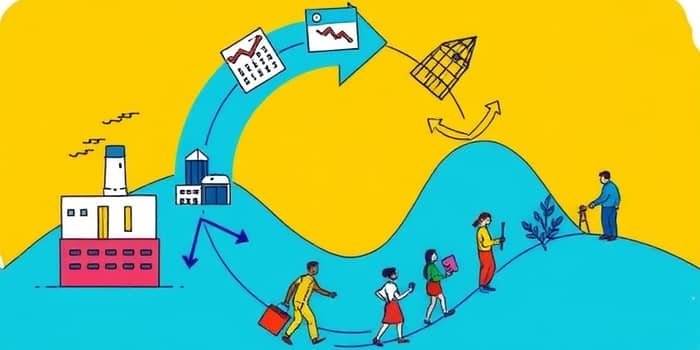
At its core, the cycle reflects an economy’s trend growth punctuated by expansions—when output and employment rise—and contractions—when those metrics retreat. This ebb and flow can last from months to years, but its impact is felt in boardrooms, family budgets, and market sentiment alike.
The Four Phases of the Business Cycle
Every cycle unfolds through four distinct phases:
- Recovery or trough phase emerges: The economy stops contracting and begins to revive.
- Accelerating expansion of business activity: Output and demand rise rapidly.
- Peak marks maximum growth momentum: Growth cannot continue indefinitely.
- Contraction or recession phase begins: Activity declines and spending retracts.
Understanding these stages allows stakeholders to anticipate shifts in hiring, investment, and consumption, and to adjust strategies accordingly.
Phase 1: Recovery
The recovery phase marks the end of a downturn. GDP transitions from negative to positive growth, but businesses remain cautious in hiring. Unemployment stays elevated even as demand for housing and durable goods picks up slowly. Companies replace depreciated capital with new investments, and lending conditions gradually improve, laying the groundwork for sustained growth.
Phase 2: Expansion
During expansion, business activity accelerates quickly. Low interest rates make borrowing attractive, fueling consumer spending and corporate investment. Unemployment falls, corporate profits climb, and stock markets often reach new highs. However, sustained demand can push prices up, leading to moderate inflation.
Phase 3: Peak
The peak represents the maximum rate of growth, after which the economy cannot maintain its momentum. Production costs rise, wages increase, and supply struggles to keep up with demand. Businesses face tighter margins and may pass costs onto consumers, sowing the seeds of slowdown.
Phase 4: Contraction
As the cycle turns downward, output contracts and unemployment rises. Consumer and business spending fall back, corporate profits shrink, and stock values slide as investors seek safer assets. If the contraction deepens and persists, it can evolve into a depression, characterized by widespread declines in income, output, and employment.
Measuring the Cycle: Key Economic Indicators
To pinpoint where the economy stands, analysts track a combination of indicators. The NBER Business Cycle Dating Committee places heavy weight on two core measures: real personal income less transfers and nonfarm payroll employment. Complementing these are:
No single metric tells the whole story. Instead, it is the holistic assessment of diverse data that guides decisions on when expansions turn to contractions and vice versa.
Predicting Recessions: Leading Indicators
While perfect foresight is impossible, certain variables often signal an impending slowdown:
- The inverted yield curve signal: Short-term bond yields exceed long-term rates, historically preceding recessions by about a year.
- Sahm rule unemployment rise: A 0.50 percentage point uptick in the three-month average signals recession.
- Leading Economic Index thresholds: Decline in six-month growth below set benchmarks suggests looming weakness.
Each tool has limitations, but together they form a robust early warning system, helping policymakers and investors brace for potential downturns.
Strategies for Businesses and Households
Armed with knowledge of the cycle’s dynamics, organizations and individuals can adopt practical measures to weather each phase:
- Build cash reserves during expansions to cushion against revenue drops.
- Maintain flexible cost structures, balancing permanent hires with contract labor.
- Diversify revenue streams and supply chains to reduce vulnerability.
- Monitor leading indicators regularly to adjust budgets and forecasts.
These approaches foster resilience, enabling stakeholders to seize opportunities in upturns and mitigate risks when the tide turns.
Putting It All Together
The economic cycle is both a challenge and an opportunity. By understanding its phases, measuring key indicators, and leveraging predictive tools, decision-makers can transform uncertainty into actionable insight. Whether you run a business, manage investments, or plan household finances, adopting a cycle-aware mindset fosters confidence and adaptability.
Ultimately, growth and recession are two sides of the same coin. Embracing this reality—rather than fearing it—empowers us to prepare for every twist and turn of the economic journey.
References
- https://prepnuggets.com/cfa-level-1-study-notes/economics-study-notes/understanding-business-cycles/overview-of-the-business-cycle/
- https://bidenwhitehouse.archives.gov/cea/written-materials/2022/07/21/how-do-economists-determine-whether-the-economy-is-in-a-recession/
- https://www.fe.training/free-resources/asset-management/stages-of-the-economic-cycle/
- https://www.clevelandfed.org/indicators-and-data/yield-curve-and-predicted-gdp-growth
- https://www.britannica.com/money/stages-of-economic-cycle
- https://www.conference-board.org/topics/us-leading-indicators/
- https://corporatefinanceinstitute.com/resources/economics/business-cycle/
- https://www.stlouisfed.org/on-the-economy/2022/sep/us-recession-what-key-economic-indicators-say
- https://institutional.fidelity.com/app/item/RD_13569_40890/business-cycle-update.html
- https://www.nber.org/research/business-cycle-dating
- https://www.congress.gov/crs-product/IF10411
- https://privatebank.jpmorgan.com/nam/en/insights/markets-and-investing/five-factors-we-use-to-track-recession-risk-and-what-they-say-now
- https://www.khanacademy.org/economics-finance-domain/ap-macroeconomics/economic-iondicators-and-the-business-cycle/business-cycles/a/lesson-summary-business-cycles
- https://www.morningstar.com/business/insights/blog/markets/leading-recession-indicators
- https://www.prodigaltech.com/blog/the-5-stages-of-a-recession-what-to-expect-and-how-to-prepare-your-business
- https://get.ycharts.com/resources/blog/recession-indicators-2025-framework/