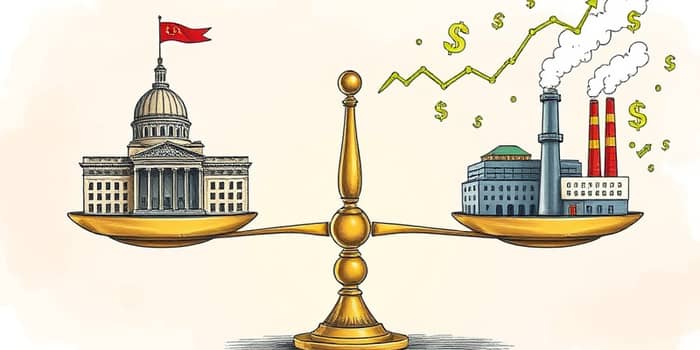
In the heart of economic policy, a timeless debate rages on: is government spending a catalyst for growth or a drag on prosperity? This question pulses with urgency as we face the latest fiscal data, revealing a complex interplay of forces.
With the federal deficit at $439 billion in FY2026, down 19% from last year, the landscape is shifting. This reduction stems from revenue growth and strategic spending shifts, offering a glimpse into our economic future.
As citizens and leaders, understanding this dynamic is crucial. It empowers us to shape policies that foster resilience and opportunity in an ever-changing world.
The Stimulus Perspective: Fueling Economic Momentum
Government spending can act as a powerful engine for growth, especially in the short term. By injecting funds into the economy, it creates ripples that boost demand and job creation.
Consider the concept of economic multipliers, where every dollar spent generates broader benefits. Local multipliers show that $1 million in public expenditure can create 10 to 30 jobs locally.
This translates to approximately $33,000 to $100,000 per job, providing tangible support to communities.
In recent times, consumer spending has surged as a key driver, aided by less restrictive policies. Dwelling investment is also on the rise, contributing to economic vitality.
The contributions to GDP are significant. In Q3, real GDP increased, fueled by consumer spending, exports, and government outlays.
Globally, this spending helps moderate growth, with projections of 3% in 2025 and 3.2% in 2026. It supports a sturdy economic framework, even amidst uncertainties.
US consumer spending is expected to grow by 2.0% in 2026 and 1.7% in 2027, down from a 2.7% average. This highlights the ongoing role of public funds in sustaining demand.
The arguments for stimulus are compelling and backed by data:
- Short-term demand boost from increased consumer activity.
- Job creation through local investment and infrastructure projects.
- GDP growth driven by government contributions during economic dips.
- Global economic stability supported by coordinated fiscal efforts.
- Enhanced public services that improve quality of life and productivity.
The Burden Argument: Weighing Down Long-Term Prosperity
Conversely, excessive government spending can become a heavy burden, stifling private sector innovation and growth. It often leads to crowding out, where public funds displace private investment.
This dynamic creates a negative wealth effect, reducing job opportunities and economic dynamism. Studies consistently show negative growth correlations with high public expenditure.
For instance, research indicates that a one standard deviation increase in government consumption relative to GDP can cut GDP growth by 0.39 percentage points.
Historical examples reinforce this view. In the 1980s, high spending in the US and Europe, exceeding 50% of GDP, was linked to economic stagnation.
Later cuts from 52.3% to 37.7% of GDP boosted growth, demonstrating the potential benefits of fiscal restraint.
The mechanisms of burden are multifaceted:
- Crowding out private sector investment through competition for resources.
- Profit squeezes from higher taxes and regulatory costs.
- Increased debt trajectories that saddle future generations.
- Reduced total factor productivity from inefficient public allocations.
- Higher unemployment rates tied to expanded government roles.
Key findings from economic studies highlight these effects in detail:
FY2026 Evidence: A Snapshot of Fiscal Realities
The current fiscal year provides concrete data to inform this debate. Receipts have increased by $112 billion, an 18% rise, driven largely by individual and payroll taxes.
Customs duties from tariffs have surged by $48 billion, a 287% increase, contributing to revenue growth. However, tariffs are estimated to reduce deficits by $2.8 trillion over a decade while cutting real GDP by 0.6%.
Outlays show a mixed picture, with overall increases offset by specific cuts. Social Security, Medicare, and Medicaid have risen by $46 billion, accounting for 44% of FY2025 outlay growth.
Net interest on debt has hit $1 trillion, up 8%, becoming the second-largest expense after Social Security. This underscores the rising debt burden that future budgets must address.
Significant reductions include a $7 billion cut to the Department of Education and an $85% decrease for the EPA. These shifts reflect policy changes and the end of pandemic-era funds.
To visualize these changes, consider the key adjustments in federal outlays:
- Education spending down due to student loan modifications.
- EPA cuts from lack of repeat clean energy grants.
- Small Business Admin reductions as pandemic loans phase out.
- Veterans Affairs increases from higher benefit usage.
- International assistance up with Foreign Military Sales revisions.
- Commerce Department boosts from CHIPS Act semiconductors.
Projections and Global Context: Navigating Future Pathways
Looking ahead, projections suggest a period of moderate growth amid spending moderation. The CBO provides historical data and forecasts that guide policy decisions.
Discretionary spending is expected to drop to 5.2% of GDP by 2026, down from 6.5%. This aligns with efforts to balance budgets and reduce fiscal pressures.
Globally, economies are adapting to similar challenges, with growth rates stabilizing around 3%. This context emphasizes the need for prudent fiscal management.
Policy implications are clear: targeted cuts can boost private investment. Historical successes, like the 1987-96 period, show that reducing spending from 52.3% to 37.7% of GDP spurred growth.
Practical steps for policymakers include:
- Focusing on efficient allocation of public funds to maximize impact.
- Monitoring debt levels to prevent long-term economic drag.
- Encouraging private sector innovation through regulatory reforms.
- Using data from sources like USAspending to track community-level effects.
- Balancing short-term stimulus with long-term sustainability goals.
Empowering Informed Choices: A Path Forward
The debate between stimulus and burden is not about choosing sides, but about finding balance. By understanding the data, we can advocate for policies that harness the best of both worlds.
Government spending, when wisely deployed, can ignite growth and support vulnerable populations. Yet, unchecked expansion risks stifling private enterprise and accruing unsustainable debt.
As we move forward, let this knowledge inspire action. Engage in civic discussions, support transparent budgeting, and demand accountability from leaders.
Together, we can shape an economy that thrives on innovation, equity, and resilience. The future is in our hands, guided by evidence and empathy.
References
- https://bipartisanpolicy.org/report/deficit-tracker/
- https://www.heritage.org/budget-and-spending/report/the-impact-government-spending-economic-growth
- https://www.deloitte.com/us/en/insights/topics/economy/global-economic-outlook-2026.html
- https://www.nber.org/digest/jan00/how-government-spending-slows-growth
- https://www.morganstanley.com/insights/articles/global-economic-outlook-2026
- https://www.richmondfed.org/publications/research/economic_brief/2025/eb_25-28
- https://www.spglobal.com/ratings/en/regulatory/article/economic-outlook-us-q1-2026-steady-as-she-goes-but-on-a-narrow-path-s101658550
- https://www.cbo.gov/data/budget-economic-data
- https://www.bea.gov
- https://www.cato.org/briefing-paper/how-federal-government-spends-67-trillion
- https://www.usaspending.gov
- https://www.cbo.gov/publication/51129
- https://www.goldmansachs.com/insights/articles/the-global-economy-forecast-to-post-sturdy-growth-in-2026