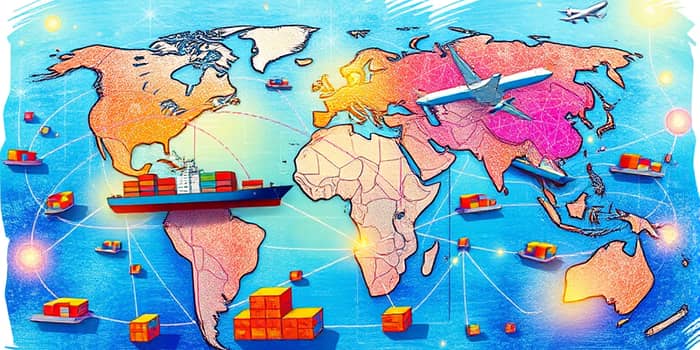
In 2025, the tapestry of international commerce reached new heights, reflecting both the power and fragility of our interwoven economies. With global trade value soaring by $500 billion in the first half of the year, nations demonstrated remarkable adaptability even as they grappled with mounting uncertainties.
Record Growth and Resilience in 2025
Global trade expanded by 2.5% quarter-over-quarter in Q2 2025, defying many forecasts of stagnation. Despite geopolitical friction and policy recalibrations, the pace of exchange in goods and services remained strong.
On an annual basis, goods trade is rising at nearly 5%, while services trade is outpacing it at about 6%. Economists predict that barring major shocks, the total value of trade will surpass the 2024 record, underscoring a resilient expansion despite volatility.
Key Drivers Fueling Trade Momentum
- Manufacturing and Technology
- Services Trade Recovery
- South–South Trade Dynamics
Manufacturing remains the main engine of growth, particularly in electronics and the automotive sector. Demand for hybrid and electric vehicles has propelled shipments across North America, Europe, and Asia.
In parallel, the trade in AI-related products has surged, reflecting a global appetite for advanced technologies. Meanwhile, services rebounded strongly in Q2, with travel, telecommunications, and information services leading the charge after a Q1 contraction.
Developing economies have played a starring role through rising South–South exchanges. Exports from least developed countries climbed by 6.1%, while their imports surged by 13.5%, spotlighting growing intra-regional integration.
Regional Trends and Trade Patterns
- Asia and Africa: Export growth at 5.3%
- South America: 2.4% expansion
- Middle East: 2.2% increase
- Europe: 0.7% growth
- North America: Imports down 4.9%
Asia continues to lead, bolstered by China’s still-sizeable surplus and India’s rapid industrialization, despite a widening deficit. Africa mirrors this momentum, with resource and agricultural exports driving its 5.3% gain.
South America and the Middle East posted moderate growth, while Europe’s exports climbed modestly. North America faced headwinds as U.S. imports contracted by 4.9%, pulling down regional figures.
Trade Imbalances, Policy Shifts, and Price Trends
Global imbalances narrowed in Q2 2025, thanks in part to U.S. policy shifts that reduced China’s surplus. The EU surplus also declined, while deficits in Japan, India, and the UK widened.
At the same time, prices of traded goods began climbing in Q2, and analysts expect price movements to contribute more to trade value growth than volume by Q3. This inflationary pressures shaping trade value signal a new phase where commodity costs and supply-chain constraints intersect.
Risks, Challenges, and Outlook for 2026
Looking ahead, policy uncertainty remains pervasive. Persistent debates over U.S. trade measures and renewed protectionist responses to global overcapacity could destabilize flows. Geopolitical tensions also loom, threatening disruptions in energy and food security.
Projections for 2026 suggest merchandise trade volume growth will slow to 0.5%, yielding a cumulative rise of just 2.9% for 2025–2026. This tempered pace emphasizes the urgent need for cooperation and strategic planning.
To sustain momentum, stakeholders must balance domestic pressures with the benefits of open markets. Strengthening supply-chain resilience, diversifying partnerships, and investing in digital infrastructure can mitigate risks and nurture growth.
Paving the Way Forward
Global trade’s story in 2025 is one of remarkable adaptability and persistent challenges. It illustrates both the power of interconnected economies and the fragility inherent in policy shifts and geopolitical strains.
By embracing innovation in manufacturing, supporting service-sector expansion, and deepening South–South collaborations, nations can build on current successes. Addressing imbalances through multilateral dialogue and easing inflationary bottlenecks will also be critical.
Ultimately, the resilience displayed this year offers a blueprint: by combining foresight, cooperation, and strategic investments, the international community can steer trade toward a stable, inclusive future.
References
- https://unctad.org/news/global-trade-25-second-quarter-track-record-highs-2025
- https://unctad.org/publication/global-trade-update-october-2025-global-trade-remains-strong-despite-policy-changes-and
- https://dataweb.usitc.gov
- https://www.youtube.com/watch?v=qq72CQ83LII
- https://oecdstatistics.blog/2025/04/17/5-things-you-should-know-about-international-trade-statistics/
- https://www.bea.gov/news/2025/us-international-trade-goods-and-services-august-2025
- https://comtrade.un.org
- https://www.oecd.org/en/data/insights/statistical-releases/2025/11/international-trade-statistics-trends-in-third-quarter-2025.html
- https://www.imf.org/en/publications/weo/issues/2025/10/14/world-economic-outlook-october-2025