Fiscal policy stands at the heart of a nation’s economic toolkit. Through the strategic use of taxation and public spending, governments seek to influence the overall health of their economies. When wielded effectively, fiscal measures can guide a country through turbulent times, foster sustainable growth, and improve living standards for citizens.
Understanding Fiscal Policy Fundamentals
At its core, fiscal policy is a powerful tool that governments use to steer their economies. By adjusting tax rates, modifying government expenditures, and managing public debt, policymakers influence aggregate demand, control inflation, and affect employment levels. These actions ripple through the economy, impacting consumer behavior, business investment, and overall confidence.
Governments collect revenue primarily through taxes, which can be structured progressively to redistribute income or incentivize specific behaviors. Public spending channels these revenues into infrastructure, education, healthcare, and defense—each sector yielding different economic multipliers and long-term benefits.
Historical Foundations and Keynesian Theory
The theoretical roots of modern fiscal policy trace back to the work of British economist John Maynard Keynes. His groundbreaking ideas emerged during the Great Depression of the 1930s, a period when laissez-faire approaches failed to revive a collapsing global economy. Keynes argued that government interventions in taxation and spending could stimulate aggregate demand and pull economies out of recession.
Keynesian economics emphasized the use of government revenue generation to shape macroeconomic activity. When private demand wanes, public spending on projects such as roads, schools, and hospitals injects income into the economy, creating jobs and boosting consumption. Conversely, during boom periods, higher taxes or reduced spending help temper overheating and curb inflationary pressures.
Key Components of Fiscal Policy
Effective fiscal policy hinges on three main components:
- Government Spending and Taxation Policies: Direct tools to influence demand and resource allocation.
- Public Debt Management: Balancing borrowing needs with long-term sustainability.
- Tax Structure and Revenue Generation: Distributing tax burdens and incentivizing growth.
By coordinating these elements, governments strive to maintain economic stability, promote equitable growth, and respond dynamically to changing economic conditions.
Objectives of Fiscal Policy
Fiscal policy operates with multiple overlapping goals, each critical to national prosperity. Among these goals are:
- Ensuring economic stability through prudent management of spending and taxation.
- Managing inflation by adjusting tax rates or reallocating funds to key sectors.
- Promoting long-term growth via investments in infrastructure, research, and human capital.
- Reducing income inequality through progressive tax systems and targeted transfers.
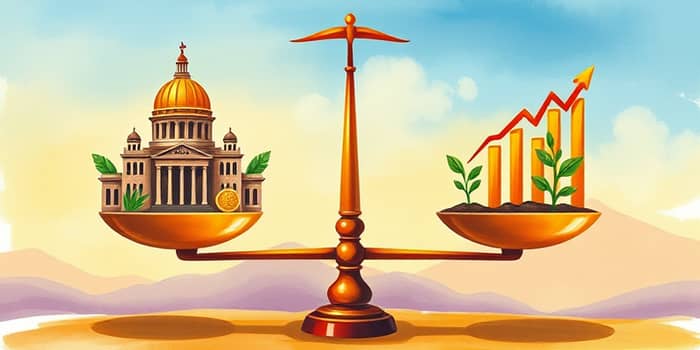
Striking the right balance between short-term stabilization and long-term development defines the art of fiscal policymaking. Decisions must account for current economic conditions, social priorities, and future debt obligations.
Stances of Fiscal Policy and Their Impacts
Fiscal policies typically fall into one of three stances, each designed for particular economic scenarios:
An expansionary approach injects funds into the economy through infrastructure projects and tax cuts, aiming to increase aggregate demand directly. Conversely, contractionary measures—raising taxes or cutting spending—help cool overheated economies and preserve fiscal sustainability.
Mechanisms of Policy Implementation
Governments influence Gross Domestic Product (GDP) via the equation GDP = C + I + G + (X – M), where G represents government purchases. By adjusting G directly and influencing consumption (C), investment (I), and net exports (X – M) through tax and transfer changes, fiscal policy steers overall economic activity.
Policymakers face trade-offs in deploying fiscal stimulus. Should resources target vulnerable populations for immediate relief? Or should they fund long-term capital investments that generate sustainable growth? Often, a balanced approach yields stronger cumulative effects, combining targeted transfers, tax incentives, and infrastructure spending.
Challenges and Future Outlook
While fiscal policy offers immense potential, it also presents challenges. Timing and magnitude matter: stimulus delivered too late or too small may fail to revive growth. Excessive debt accumulation can undermine investor confidence, leading to higher borrowing costs and reduced fiscal flexibility.
Looking ahead, policymakers must adapt to evolving economic landscapes. Digital transformation, climate change, and demographic shifts require innovative fiscal responses. Green infrastructure investments, retraining programs for aging workforces, and digital taxation frameworks illustrate emerging policy frontiers.
Ultimately, the effectiveness of fiscal policy depends on rigorous analysis, transparent decision-making, and effective communication. By continuously monitoring macroeconomic indicators and adjusting course, governments can harness fiscal tools to build resilient, inclusive economies capable of thriving in an ever-changing world.
References
- https://equalsmoney.com/financial-glossary/fiscal-policy
- https://fiveable.me/key-terms/ap-gov/fiscal-policy
- https://www.ebsco.com/research-starters/business-and-management/fiscal-policy
- https://www.imf.org/en/publications/fandd/issues/series/back-to-basics/fiscal-policy
- https://en.wikipedia.org/wiki/Fiscal_policy
- https://www.econlib.org/library/Topics/HighSchool/FiscalPolicy.html
- https://www.federalreserve.gov/faqs/money_12855.htm
- https://www.worldbank.org/en/topic/fiscalpolicy