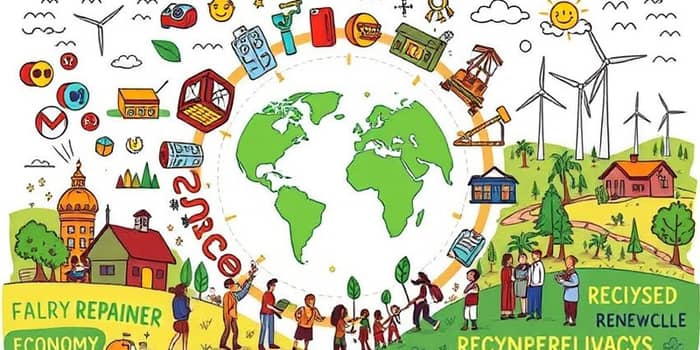
Our global economy has long followed a linear path: extract, produce, use, and discard. This model has fueled unprecedented growth but left a legacy of waste, resource depletion, and environmental strain. As we stand at a crossroads, the circular economy offers a profound shift in how we interact with materials, products, and natural systems.
By embracing restorative principles, businesses and individuals can transform waste into value, decouple growth from finite resource use, and build resilient communities. This comprehensive approach invites us to redesign systems with renewal at their heart, ensuring that materials and products remain in continuous, regenerative loops.
Principles of the Circular Economy
The circular economy is guided by three interrelated pillars that redefine growth and resource use:
design out waste and pollution from the earliest stages, ensuring that products and processes leave no harmful residues behind.
keep products and materials in use for as long as possible through strategies such as reuse, repair, refurbishment, and recycling.
regenerate natural systems using renewables and techniques that restore ecosystems, enhance soil health, and increase biodiversity.
Together, these principles challenge the conventional throwaway culture and invite innovation at every level—from product design to end-of-life management.
Comparing Linear and Circular Models
Environmental, Economic, and Social Benefits
Transitioning to a circular economy unlocks a spectrum of benefits that span environmental resilience, economic opportunity, and social well-being. Consider the following highlights:
- halve CO2 emissions by 2030 compared to current trajectories, reducing the climate burden significantly.
- up to 70% material savings against traditional extraction, lowering pressure on raw resources.
- protects biodiversity and ecosystems through regenerative land use and reduced pollution.
- cost savings on raw materials and waste treatment bolster corporate competitiveness and profitability.
- 95% energy savings in brick reuse and 60% CO2 reduction from reusable packaging exemplify immediate impacts.
- Job creation in repair, remanufacturing, and recycling sectors fosters inclusive growth.
By shifting to renewable energy sources, designing products for longevity, and closing material loops, communities around the world can slash emissions, conserve finite reserves, and nurture natural capital.
Real-World Examples of Circular Success
From fashion and food to heavy industry, pioneers are demonstrating that circular strategies drive innovation and value:
- Consumer & Retail: Patagonia’s take-back program refurbishes and resells garments; IKEA offers second-hand furniture sales; Sheedo creates seed-embedded paper that grows plants.
- Food & Waste: Too Good To Go connects diners to surplus restaurant meals; Minamisanriku BIO in Japan converts 10,000 tonnes of organic waste into 66,600 kWh of electricity and 2,150 tonnes of fertilizer annually.
- Industrial & Packaging: Birplast transforms plastic waste into new polymers; Danish deposit-return schemes achieve high recycling rates for bottles and cans; Aalborg Industrial Symbiosis matches SME byproducts to reduce waste costs.
These success stories prove that circular models are scalable, profitable, and capable of delivering tangible environmental and social impacts.
Transition Strategies for Businesses and Individuals
Embarking on the circular journey involves targeted actions at every stage of the value chain. Key strategies include:
1. Design for longevity and disassembly: Create products that are easy to repair and upgrade, with standardized components and modular structures.
2. Digital tracking and traceability: Use AI and IoT systems to monitor materials throughout their lifecycle, facilitating recovery and recycling.
3. Collaborative platforms and symbiosis: Partner with other organizations to exchange waste streams, share resources, and co-develop closed-loop systems.
4. Business model innovation: Shift from selling products to offering services—leasing, sharing, or product-as-a-service models keep ownership aligned with sustainability outcomes.
5. Policy and regulatory alignment: Advocate for standards, incentives, and regulations that support circular practices, level the playing field, and drive widespread adoption.
Future Outlook and Calls to Action
The circular economy holds the promise of decoupling global prosperity from resource depletion and pollution. As populations grow and climate risks intensify, embracing restorative design and closed-loop systems becomes imperative.
Individuals can contribute by repairing instead of replacing, purchasing refurbished items, and properly sorting waste for recycling. Simple actions—like choosing refillable packaging or donating unused goods—aggregate to powerful change.
Businesses should audit material flows, set measurable circularity targets, and invest in R&D for sustainable materials and processes. Collaborative innovation, from industrial symbiosis to cross-sector alliances, will unlock new value streams.
Policymakers can accelerate the transition by implementing deposit-return schemes, mandating recycled content, and funding infrastructure for repair, reuse, and recycling hubs.
Together, we can move from a linear system built on scarcity to a circular model defined by abundance, resilience, and shared prosperity. The time to act is now. By rethinking consumption and production, we pave the way for a healthier planet and more equitable future.
References
- https://www.immerse.education/beyond-syllabus/economics/what-is-the-circular-economy-definition-benefits/
- https://thereusepeople.org/the-circular-economy-how-reuse-is-shaping-the-future-of-consumption/
- https://youmatter.world/en/definition/definitions-circular-economy-meaning-definition-benefits-barriers/
- https://www.climateimpactstracker.com/circular-economy-examples/
- https://www.okonrecycling.com/consumer-recycling-initiatives/learn-about-recycling/what-is-circular-economy/
- https://www.group.sener/en/insights/from-waste-to-resource-6-examples-of-circular-economy/
- https://www.interlakemecalux.com/blog/circular-economy
- https://www.weforum.org/stories/2020/12/circular-economy-examples-ikea-burger-king-adidas/
- https://greenly.earth/en-us/blog/company-guide/circular-economy-definition-and-principles
- https://stateofgreen.com/en/news/10-examples-of-circular-economy-solutions/
- https://www.ellenmacarthurfoundation.org/topics/circular-economy-introduction/overview
- https://www.microbank.com/en/blog/p/10-examples-of-the-circular-economy.html
- https://www.epa.gov/circulareconomy/what-circular-economy
- https://www.europarl.europa.eu/topics/en/article/20151201STO05603/circular-economy-definition-importance-and-benefits
- https://fsc.org/en/blog/what-is-circular-economy