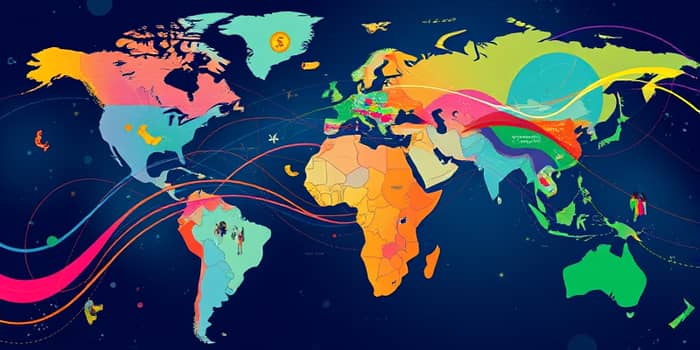
Imagine a world where money moves as freely as people, crossing borders and continents in pursuit of growth and opportunity.
This is the essence of capital flows, a powerful force that mirrors the global movement of labor.
Throughout history, periods of high capital mobility have coincided with waves of migration, driven by economic incentives and policy changes.
Understanding this interplay is key to navigating today's financial landscape.
Capital flows are not just dry economic terms; they are the heartbeat of globalization, pulsing through our lives.
The Historical Tides of Money and Movement
To grasp capital flows, we must look back at how they evolved alongside human migration.
This journey spans political-economy epochs that shaped our modern world.
- First wave of globalization (1870-1913): Free trade and the gold standard enabled mass migration of 60 million Europeans.
- Interwar period (1918-1939): Economic turbulence led to chaotic and diminished flows.
- Bretton-Woods era (1945-early 1970s): Restricted private capital mobility prioritized domestic goals.
- Post-1970s (second globalization wave): Capital mobility surged with accelerating migration from non-European sources.
These eras show that capital and labor flows are deeply intertwined.
When people move, money often follows, seeking new horizons and profits.
Understanding the Mechanics of Capital Flows
Capital flows balance current account deficits through various financial instruments.
They can be net or gross, with gross flows often much larger due to offsetting movements.
- Net capital flows involve monetary deposits, currency, bonds, equity, or real property claims.
- Gross flows averaged $4.9 trillion annually among industrial countries from 1995 to 2003.
- Direct investment saw industrial countries as net exporters, while LDCs received inflows.
These flows are driven by multiple factors that shape global finance.
Key drivers include economic imbalances, where capital seeks high-return areas.
Migration links reduce informational frictions, especially for culturally distant countries and sensitive assets.
Policy factors like taxes and forex controls can curb or encourage mobility.
Political and geopolitical events, such as nationalism, also play a crucial role.
The Synergy with International Migration
Migration is more than just people moving; it facilitates financial flows across borders.
Skilled migrants boost information flow, making capital movement smoother and more efficient.
- Remittances act as a third leg of globalization, alongside trade and capital.
- Evidence from gravity models shows migration correlates strongly with bilateral financial flows.
- This synergy is highest where information frictions are significant, such as in developing regions.
For instance, during the first globalization wave, capital followed labor to exploit New World resources.
Today, migration from Latin America, Asia, and Africa accelerates capital inflows to host countries.
This dynamic highlights how human mobility can reduce global inequalities by directing resources where needed.
Recent Trends and Data Insights
Up to the early 2000s, capital flows dominated by industrial countries, but LDCs gained share.
In 2003, gross flows totaled $6.4 trillion, with industrial countries accounting for 84%.
The U.S. emerged as a hub, absorbing global savings and attracting investments despite deficits.
- LDC central banks often buy U.S. debt as reserves for currency backing.
- Measurement challenges exist, with illicit financial flows expanding and policies uncertain.
- Global savings shifts contrast with 19th-century patterns, reflecting modern economic structures.
This data underscores the importance of understanding flows for policy and investment decisions.
Conceptual Frameworks and Global Interactions
Open economy adjustments show how migration alters labor supply in source countries.
Capital flows fill savings-investment gaps via current accounts, promoting balance.
Trade, capital, and migration complement each other in open eras but can substitute during restrictions.
- Capital and labor are not zero-sum; both move to high-wage and high-profit areas.
- Inequality links reveal flows reduce disparities by directing resources efficiently.
- This is tied to resource abundance, such as land or gold in historical contexts.
For example, in the New World, capital followed labor to exploit natural riches.
This framework helps us see the broader economic picture and anticipate future trends.
Policy Implications for a Better Future
Capital flows and migration present both opportunities and challenges for policymakers.
Restrictions on labor, like quotas and visas, and on capital, such as taxes and controls, shape global mobility.
The OECD enhances benefits while building resilience against economic shocks.
- Capital inflows are key for LDCs' growth, providing essential financing.
- The U.S. attracts flows despite deficits, highlighting its economic strength.
- Myths exist, such as the idea that capital inflows must match outflows, which is not accurate.
By embracing informed policies, nations can harness flows to foster prosperity.
This requires balancing openness with safeguards to protect vulnerable economies.
Practical Guidance for Navigating Capital Flows
For individuals and businesses, understanding capital flows can unlock new opportunities.
Monitor trends in migration and policy changes to anticipate financial movements.
Invest in regions with high growth potential driven by both capital and labor inflows.
- Diversify investments across borders to mitigate risks from economic imbalances.
- Support initiatives that reduce informational frictions, such as migrant networks.
- Advocate for policies that promote sustainable and inclusive globalization.
For policymakers, focus on creating environments that attract both talent and capital.
This can include improving infrastructure, education, and regulatory frameworks.
By doing so, we can build a world where money and people flow freely for mutual benefit.
Capital flows are not just about economics; they are about human aspiration and connection.
They remind us that our global community is bound by shared dreams of progress.
Embrace this knowledge to make informed decisions that inspire change and growth.
Let the movement of capital be a force for good, driving innovation and unity across borders.
References
- https://openknowledge.worldbank.org/entities/publication/c182bbba-fd88-53f4-9f94-ec7abacbebac
- https://repositorio.cepal.org/server/api/core/bitstreams/281f7e8f-c927-4c18-a970-636387899f30/content
- https://www.econlib.org/library/Enc/InternationalCapitalFlows.html
- https://www.oecd.org/en/topics/sub-issues/capital-flows-and-investment-standards.html
- https://www.nber.org/programs-projects/projects-and-centers/7093-career-global-capital-flows
- https://www.cato.org/publications/currency-capital-flows-trade-balances-jobs
- https://www.cfr.org/economics/capital-flows